Nolan Rappé Plyometric Progressions for Throwing Program
Plyometric Progressions for Throwing Program
This overview details the proper plyometric progressions required to prepare the body for a throwing program. This gradual approach helps with enhancing stress absorption, power generation, and the efficiency of the stretch-shortening cycle (SSC). This culminates in modified throws that closely simulate the throwing action. This helps systematically build stress while cultivating confidence within the athlete. This sequence is designed to progressively load the tissues of the arm to better facilitate more confident throwing mechanics once the throwing program has started.
Purpose
The intent of this detailed plyometric continuum is to systematically load the tissues of the arm to drive adaptation through proper build of stress. Athletes will typically follow a two-handed to one-handed progression within each phase. Athletes, coaches, and movement professionals should keep in mind that this is a continuum rather than a specific, stepwise progression. Athletes may begin in phase one and blend into phases two and three within the same session or in a condensed amount of time. This continuum can even be used within session to structure the order of the chosen plyometrics. This program should be monitored by a movement/rehab professional or coach. Keep in mind that these are simply examples and coaches/movement professionals should take the general loading strategy and apply it with their own exercise selection preferences to fit the athlete. All unilateral exercises can be done on both sides.
Plyometric Continuum
Phase 1: Stress Absorption (Eccentric Emphasis)
Objective: Develop ability to effectively absorb force and expose elbow to high contractile speeds
Two-Handed Progression
| Exercise |
Set |
Rep |
Notes |
Link |
| Supine MB Catch |
2 |
10 |
Absorb first, then “stick” rep once comfortable |
Link |
| Fall Into Wall Elbows Bent |
2 |
10 |
|
Link |
| Fall into Wall Elbow Straight |
2 |
10 |
|
Link |
| Supported or Unsupported Nordic Falls |
2 |
8-10 |
Can support with band under armpits |
Link |
One-Handed Progression
| Exercise |
Set |
Rep |
Notes |
Link |
| Trampoline “Force Acceptance” Catch |
2 |
20 |
Throw with opposite arm and “catch” with involved arm |
Link |
| Quadruped Plyo Ball T Drop Deceleration |
2 |
20 |
Drop and “Stick” |
Link |
| Off Box Push Up Position “Drop” |
2 |
6-8 |
Try to maintain scapular stability |
Link |
| Half Kneeling Over the Shoulder Deceleration Catch |
2 |
15-20 |
Play with arm angles – cue is to slow body down right after catch |
Link |
Phase 2: Isolated Concentric Exposure
Objective: Concentric focused development
Two-Handed
| Exercise |
Set |
Rep |
Notes |
Link |
| Supine Paused MB Press |
3-4 |
4-6 |
Explosive after pause |
Link |
| Supine Paused OH MB Throw |
3-4 |
4-6 |
Fast up after pause |
Link |
| Standing MB Chest Pass |
3-4 |
4-6 |
Explosive, concentric only |
Link |
| Paused Tall-Kneeling LM Press |
3-6 |
2-4 |
Explosive |
Link |
One-Handed
| Exercise |
Set |
Rep |
Notes |
Link |
| 90/90 Concentric Only IR Rebounder/Plyo |
3-4 |
10-12 |
Promote shoulder IR independent of ER |
Link |
| Push Up Position Box “Bound” w/Pause |
3-4 |
4-6 |
Short load, pause, then go |
Link |
| Paused Reverse Throw (Half kneeling) |
2 |
10 |
Try to create full torso turn |
Link |
| Half Kneeling Paused Landmine Press |
2-6 |
2-4 |
Explosive |
Link |
Phase 3: Low Amplitude Stretch Shortening Cycle (SSC)
Objective: Begin to integrate the eccentric and concentric phases with minimal delay, focusing on quick, reactive movements.
Two-Handed
| Exercise |
Set |
Rep |
Notes |
Link |
| Bilateral Standing MB Chest Press |
3-4 |
4-6 |
Promote speed |
Link |
| Double Arm “Box Hop” |
3-4 |
4-6 |
Small load, low box |
Link |
| OH MB Short Amp Lat “Dribbles” |
2 |
10-15 |
Short, quick – drive with pec/lat |
Link |
| Supine MB Plyo Press |
3-6 |
2-4 |
Quickly catch/press |
Link |
One-Handed
| Exercise |
Set |
Rep |
Notes |
Link |
| ER/Y Band Dribbles |
3-4 |
6-8 seconds |
Move arm as quickly as possible between each band |
Link
Link
|
| Prone/Quadruped Y/T Ball Drops |
2-3 |
30-50 reps |
Emphasize stable shoulder blade |
Link |
| Low Amp Wall Plyo Ball Wall dribbles |
2 |
40-50 |
Drive motion from shoulder, not wrist |
Link |
| LM Drop Catches |
2-6 |
2-4 |
Quickly drop/catch |
Link |
Phase 4: High Amplitude Stretch Shortening Cycle (SSC)
Objective: Increase the intensity and amplitude of the SSC movements to progressively load UCL.
Two-Handed
| Exercise |
Set |
Rep |
Notes |
Link |
| MB “Fake” Throw Scoop Toss |
3-4 |
4-6 |
Work to decelerate as quickly as possible |
Link |
| Assisted/Resisted Plyo Push Up |
3-4 |
4-6 |
Start assisted – work to resisted |
Link |
| Alternating Lateral MB OH Slams |
2 |
10-15 |
Get into the hip, rotate the back leg |
Link |
| Supine MB Stretch OH Throw |
3-6 |
2-4 |
Full stretch and go quickly |
Link |
One-Handed
| Exercise |
Set |
Rep |
Notes |
Link |
| Off Box Land into Reactive Bound |
3-4 each side |
6-8 reps |
Catch and explode quickly |
Link |
| Half Kneeling Landmine Barbell Catch/Press |
3-4 |
4-6 |
Catch and explode quickly |
Link |
| Large Amplitude Plyo Wall Dribbles (ER/IR) |
2 |
40-50 |
Allow arm to lay back |
Link |
| Lat-Based OH MB “Dribbles” |
2 |
15-20 |
Drive with lat/pec |
Link |
VI. Phase 5: Modified Throws
Objective: Transition plyometric gains into throwing-specific movements, integrating technique with power.
| Exercise |
Set |
Rep |
Notes |
Link |
| Mound-Based OH Medball Work |
2-3 |
4-6 throws |
Make sure to evenly distribute pushing force through both hands to prevent excessive loaded layback |
Link |
| Throwing Sock/Throw Holds |
2 |
10-15 throws |
Use 11 oz to 1 lb ball for trained individuals |
Link |
| Football Catch |
1-2 |
15-30 |
|
|
| Plyoball Drills |
1-2 |
6-10 each drill |
Focus placed on proposed mechanical changes at around 50-60% RPE |
-Coaches choose |
Implementation Notes
- As mentioned before, this can be treated as a continuum and not a strict “progression” based on athlete presentation
- Pay close attention to athlete response both during and after (how athlete recovers from session to session) implementation
Pre/Post Throw Routine – Phase Specific
Goal of the pre-throw routine is to help prepare the body for the specific demands of the specific phase of throwing. Athletes will complete these exercises after a total body dynamic warm up and resistance band routine. This routine should be created by the movement professional or strength coach and tailored to individual athlete needs utilizing the movements below as a guideline.
I. Pre-Throw Exercises
Phase 1 – Fascial Sling Emphasis, Total Body Athleticism, LE/UE Plyometrics
| Exercise |
Set |
Rep |
Notes |
Link |
| Dynamic Reverse Lunge with Twist + Side Bend |
1 each side |
6-8 |
Emphasize stability/balance throughout |
Link |
| High Plank Opposite Foot Touch |
1 |
8-10 each |
Drive hips back with hands |
Link |
| Medial Hop Into 90 Degree Turn |
1 |
4-6 each side |
Stick landing – minimal knee bend after initial foot contact |
Link |
| Plyo Push Up |
1 |
4-6 |
Can do assisted/resisted or on elevated surface |
Link |
Phase 2 – Total Body Athleticism – Exposure to End Range Positions
| Exercise |
Set |
Rep |
Notes |
Link |
| Lunge Stance Band Forward Press into OH Reach |
1 each side |
10 |
Keep rib cage down |
Link |
| Standing Shoulder CAR |
1 |
8-10 each |
Keep rib cage still |
Link |
| Lateral Heiden Jump (Load and Go) |
1 |
6 each side |
Load into the hip |
Link |
| Banded Eccentric Shoulder IR “Catches” |
1 |
8 |
Quick release “catch” |
Link |
Phase 3 – End Range Exploration, Rate of Force Development Potentiation
| Exercise |
Set |
Rep |
Notes |
Link |
| Quadruped Hip Airplane |
1 each side |
8-10 |
Belt buckle and sternum move at the same rate |
Link |
| Half Kneeling Bow and Arrow |
1 |
10 |
Purely spin in the thoracic spine – limit side bend |
Link |
| Single Leg Hop into Lateral Bound |
1 |
4-6 each side |
Spend as little time on ground between hops |
Link |
| Supine Band Plyo Lat Pullover w/Slow Eccentric |
1 |
6 |
Quick, isolated lat activation |
Link |
Cool Down Tips – To Be Done Following Prescribed Post Throw Strength Work
| Exercise |
Set |
Rep |
Notes |
Link |
| Standing or Half Kneeling Shoulder CAR |
1 each side |
8-10 |
Keep ribs still while standing |
Link |
| Crab Position Breathing |
1 |
10 breaths |
Pull shoulder blades together at top |
Link |
| Quadruped Thread the Needle with Horizontal Adduction Emphasis |
1 |
10 each side |
1 inhale/exhale at end range for each rep |
Link |
| Hooklying Cadence Belly Breathing Progression |
3-5 min total |
I. 2 Second Inhale, 3 Second Hold, 6 Second Exhale
II. 3 Second Inhale, 4 Second Hold, 8 Second Exhale
|
Follow cadence progression listed here |
Link |
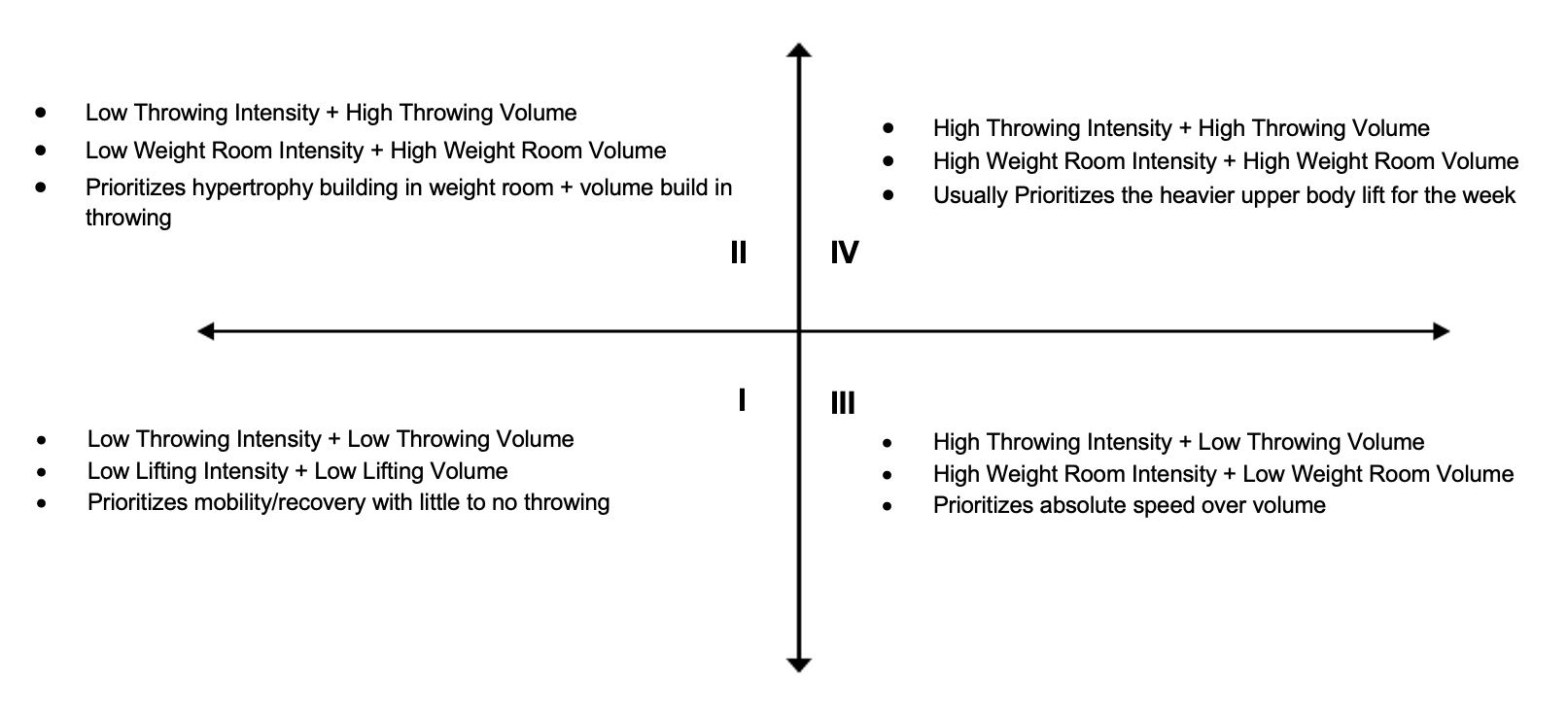
Training Schedule Recommendations – Application of Daniel Bove’s “Quadrant System” (High/Low Model)

*Understanding how to properly organize throwing and training/rehab sessions allows for adequate tissue and central nervous system (CNS) recovery. This efficient recovery is essential in avoiding setbacks and frequent need for “deload” periods.