The Yips: A Love Story
admin2026-02-17T14:57:55-05:00I cried last week — about five times. Anyone [...]
I cried last week — about five times. Anyone [...]
At the ARMory we study OUTLIERS so my players can become THAT GUY! While science seeks to find common denominators among the normal, it propagates “The Cult of Average.” Average is a code word for mediocre, and that is not our goal at The Florida Baseball ARMory.
A well-executed one-legged hinge is vital to increasing impulse and improving velocity. But, not all hinges are the same. The single-leg hinge must be nuanced to link the athlete’s hardware to his software. This requires an in-depth investigation and appreciation of each athlete’s unique physical characteristics and movement preferences.

Unless you’ve been living in the baseball equivalent of a Himalayan monastery, you’ve heard pitching and hitting coaches avowing the importance of “hip-to-shoulder separation.” I’m not exactly sure when it began, but sometime in the last several years, someone coined the term, and it spread like wildfire. According to advocates of this tenet, pitchers and hitters should rotate the pelvis while the torso remains closed for as long as possible. The resultant diagonal stretch through the trunk allows the athlete to take advantage of the elastic properties of the abdominals, and chest muscles to store and then unload energy to be transferred from the lower half to the arm or bat.
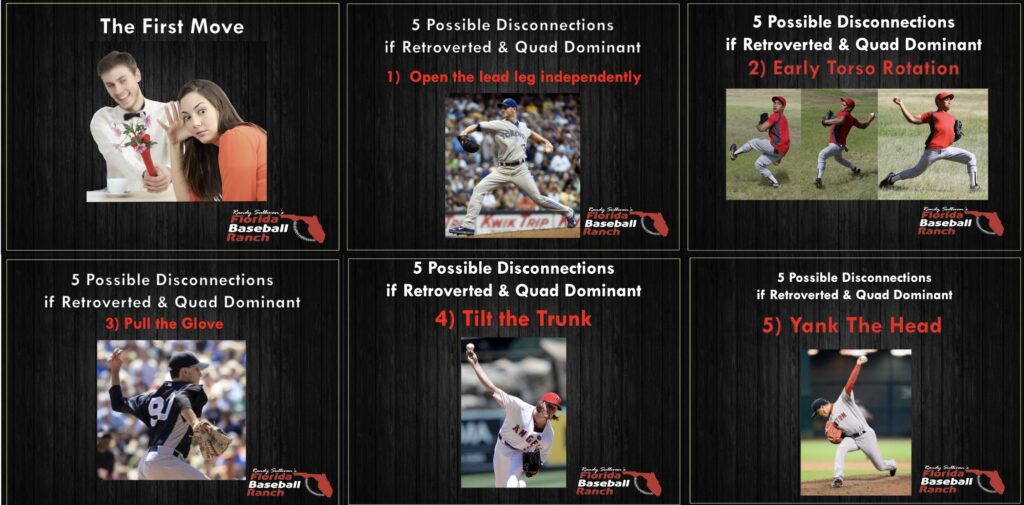
The bottom line is this: Pitching is like picking up chicks. The first move is critical. You have to get the first move right, or you probably don’t have much of a chance.
To change a movement, you have to change the mover. To stabilize the back leg (thereby increasing impulse) the athlete must have enough mobility to get into a position that optimizes the length-tension relationships in all of the muscles surrounding the hip.
Nearly every other day, we get a call from a player or a parent or coach of a player with arm pain that has bee diagnosed as tendonitis. The player feels a little pain in their shoulder or elbow after throwing. It’s nothing major -just a pinch or a dull ache. They ice it, take some Motrin, Advil, or Tylenol, grease it up with Icy Hot and try to “throw through it.” The pain persists and eventually gets worse. They take a few days off, but when they start throwing, it hurts again.
The UCL, Labrum, and rotator cuff aren’t the most highly vascularized tissues, they do receive some blood flow, and therefore under the right conditions, they are capable of remodeling themselves to resist the stresses under which they are placed.
The first thing Justin Verlander said to me is “I’ve got a problem. In my start today, I was sitting at 88-‐91. That’s not going to get it done. I’m a stuff guy. I’ve always had great stuff. I’m not the type that will be ok learning to pitch in the low 90s. I need to get my velocity back."
24 mph in just over three years? For some, that may seem unrealistic, but gains like that are not uncommon here at The Florida Baseball ARMory. They happen so frequently that we’re no longer surprised. We’re always thrilled, but never surprised. And with the right individualized training plan, they can happen for anyone, including you.