

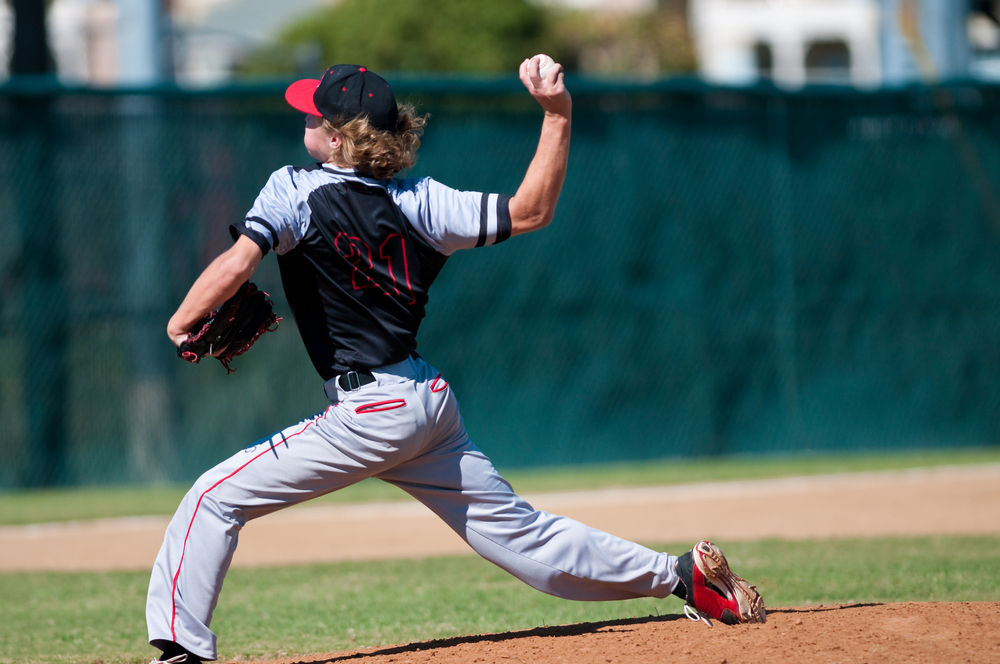
You're doing everything right. You track every pitch. You pull him when he hits his number. You make sure he rests the required days between outings. And yet, somehow, your son's elbow still aches after every start.
You're not alone. And here's the part nobody wants to say out loud: pitch counts, as they're commonly used, aren't actually protecting your son's arm.
Before you come at me with torches and pitchforks, hear me out. I'm not saying volume doesn't matter. It does. But the way most coaches and parents use pitch counts creates a dangerous illusion of safety — a checkbox that lets everyone sleep at night while the real problem goes completely unaddressed.
The Uncomfortable Truth About Volume-Based Thinking
For decades, the injury prevention conversation in baseball has been stuck on a simple formula: throw less = stay healthy. Limit the pitches. Cap the innings. Manage the rest days. And if a kid still gets hurt? Well, he must have thrown too many.
But research tells a very different story. Dowling and colleagues (1) published a comprehensive review of workload monitoring in baseball throwers and found that despite the explosion of monitoring tools and workload metrics, the predictive value of current strategies for injury risk remains limited. Let that sink in. We've been counting pitches for over twenty years, investing in apps and spreadsheets and rest-day calculators — and injury rates haven't budged.
Why? Because the model is incomplete. Counting pitches treats every throw as equal. But they're not. Not even close. A relaxed 75% fastball in the second inning and a max-effort heater in a full-count, bases-loaded situation in the sixth put wildly different demands on the body. The number on the counter is the same. The stress on the arm is not.
Oyama's (2) work in pitching kinematics confirmed this: volume alone does not determine joint stress. The way an athlete moves has as much influence on tissue load as the number of pitches thrown. Two kids can throw 60 pitches in a game — one walks away fine, the other's elbow is barking. Same pitch count. Completely different movement organization.
It's Not How Much He Throws. It's How He Throws.
Scarborough and colleagues (3) showed that different kinematic sequence patterns are associated with different shoulder and elbow torques. In plain English: two pitchers with the same workload experience completely different levels of stress depending on how well their body sequences the throw. Timing, rhythm, the way energy transfers from the ground through the legs, trunk, and arm — that's what determines whether a pitch builds the arm up or tears it down.
Every rep either reinforces healthy structure or erodes it. Every single one. And no pitch count in the world can tell you which category a throw falls into.
This is why we see kids who “did everything right” end up in Dr. Andrews' office. Their parents followed every guideline. Their coaches tracked every inning. But nobody was paying attention to how the body was organizing itself under the stress of competition.
So What Actually Protects the Arm?
At The Florida Baseball ARMory, we focus on something we call load ownership. It's a shift from asking “how much did he throw?” to asking “how did his body handle what he threw?”
Load ownership means the athlete's movement system is organized well enough to distribute stress efficiently across the entire kinetic chain — not just dump it all into the elbow and shoulder. When the legs create force effectively, when the trunk transfers that energy with proper timing, and when the arm works as the final link in a well-coordinated chain, the tissues stay healthy even under heavy workloads.
But when that chain breaks down — when the front leg leaks energy, when the trunk opens too early, when the arm has to do the work of the whole body — that's when tissues fail. Not because of pitch number 67. Because of disorganized pitch number 67.
The research on movement variability supports this powerfully. Hamill, James and colleagues (4,5) introduced the variability-overuse hypothesis, which found that athletes don't get hurt simply from doing too much. They get hurt from doing the same thing too similarly, too often. When a pitcher repeats the exact same movement pattern with no variation, the same tissues absorb the same forces over and over. It's not the volume that kills you. It's the monotony.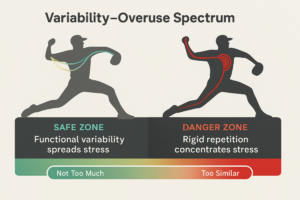
Healthy pitchers actually show more functional variability from throw to throw — subtle differences in how they achieve the same outcome. That variability spreads the load across different tissues and joint paths, giving each structure natural micro-rest cycles within the throwing motion itself. It's the body's built-in insurance policy.
What Parents Should Actually Be Looking For
Instead of watching the pitch counter, start watching your son's movement. Is his delivery getting shorter and tighter as the game goes on? Is he losing his rhythm? Is his front leg collapsing instead of bracing? Is his trunk rotating earlier than it did in the first inning?
These are the real warning signs. Not the number on the clicker.
Of course, most parents aren't trained biomechanists — and they shouldn't have to be. That's where working with someone who actually understands the science of movement becomes essential. Not someone who watched a YouTube video about arm slots. Not someone whose only qualification is that they played a couple of years of minor league ball. Someone who understands how the body organizes itself under stress, and more importantly, how to recognize when that organization is breaking down.
Building an Arm That Can Handle the Work
The goal isn't to avoid stress. The body needs stress to adapt and get stronger. The goal is to make sure the stress your son encounters is being managed by a well-organized system.
At The Florida Baseball ARMory, every pitcher we work with gets a comprehensive assessment — not just a velocity reading and a pat on the back. We look at how force interacts with the ground. We analyze segmental timing and sequencing. We examine how the arm decelerates. We identify where energy leaks and where stress concentrates. Then we build a hyper-individualized training plan that doesn't just chase velocity — it builds the organizational foundation that makes velocity safe and sustainable.https://enfoco.ffyb.uba.ar/tag/vih/
Because here's the bottom line: the safest arm isn't the one that throws the fewest pitches. It's the one that's best organized to handle the pitches it throws.
Your son's arm deserves more than a pitch count. If you're ready to find out what's really going on inside his delivery — and build a plan that actually protects him — call us at 866-787-4533 or schedule a Precision Strike One-on-One appointment at floridabaseballarmory.com. Stop guessing. Start knowing.
References:
- Dowling, B., McNally, M. P., Chaudhari, A. M. W., & Oñate, J. A. (2020). A review of workload-monitoring considerations for baseball throwers. Journal of Athletic Training, 55(9), 911-917. https://doi.org/10.4085/1062-6050-0511-19
- Oyama, S. (2012). Baseball pitching kinematics, joint loads, and injury prevention. Journal of Sport and Health Science, 1(2), 80-91. https://doi.org/10.1016/j.jshs.2012.06.004
- Scarborough DM, Linderman SE, Sanchez JE, Berkson EM. Baseball Pitchers’ Kinematic Sequences and Their Relationship to Elbow and Shoulder Torque Production. Orthop J Sports Med. 2019 Jul 29;7(7 suppl5):2325967119S00429. doi: 10.1177/2325967119S00429. PMCID: PMC8822081.
- Hamill J, Palmer C, Van Emmerik RE. Coordinative variability and overuse injury. Sports Med Arthrosc Rehabil Ther Technol. 2012 Nov 27;4(1):45. doi: 10.1186/1758-2555-4-45. PMID: 23186012; PMCID: PMC3536567.
- James, C. R. (2004). Considerations of movement variability in biomechanics research. In N. Stergiou (Ed.), Innovative analyses of human movement (pp. 29–62). Human Kinetics.
About the Author:

Randy Sullivan, MPT, CSCS
CEO, Florida Baseball ARMory
Our founder and CEO, Randy Sullivan wears a bunch of hats: Physical Therapist, Baseball Instructor, Certified Strength & Conditioning Specialist, Paid Player Development Consultant to MLB teams, Public Speaker and of course an Author.