

He was everything a college coach should want. Outstanding command. Mature pitch sequencing. He could locate his fastball to both sides, change speeds, and compete deep into games without flinching. There was just one problem: his fastball sat 83 to 85 mph. And in today's recruiting landscape, that's invisible.
He'd tried everything. A six-week long-toss program. A free online weighted-ball protocol. A “velo camp” near his hometown. None of it moved the needle. His parents were frustrated. He was frustrated. And the recruiting clock was ticking.
When he walked into The Florida Baseball ARMory at 17 years old, we didn't start by telling him to throw harder. We started by asking a completely different question: Why isn't his body letting him throw harder?
The Story the Data Told
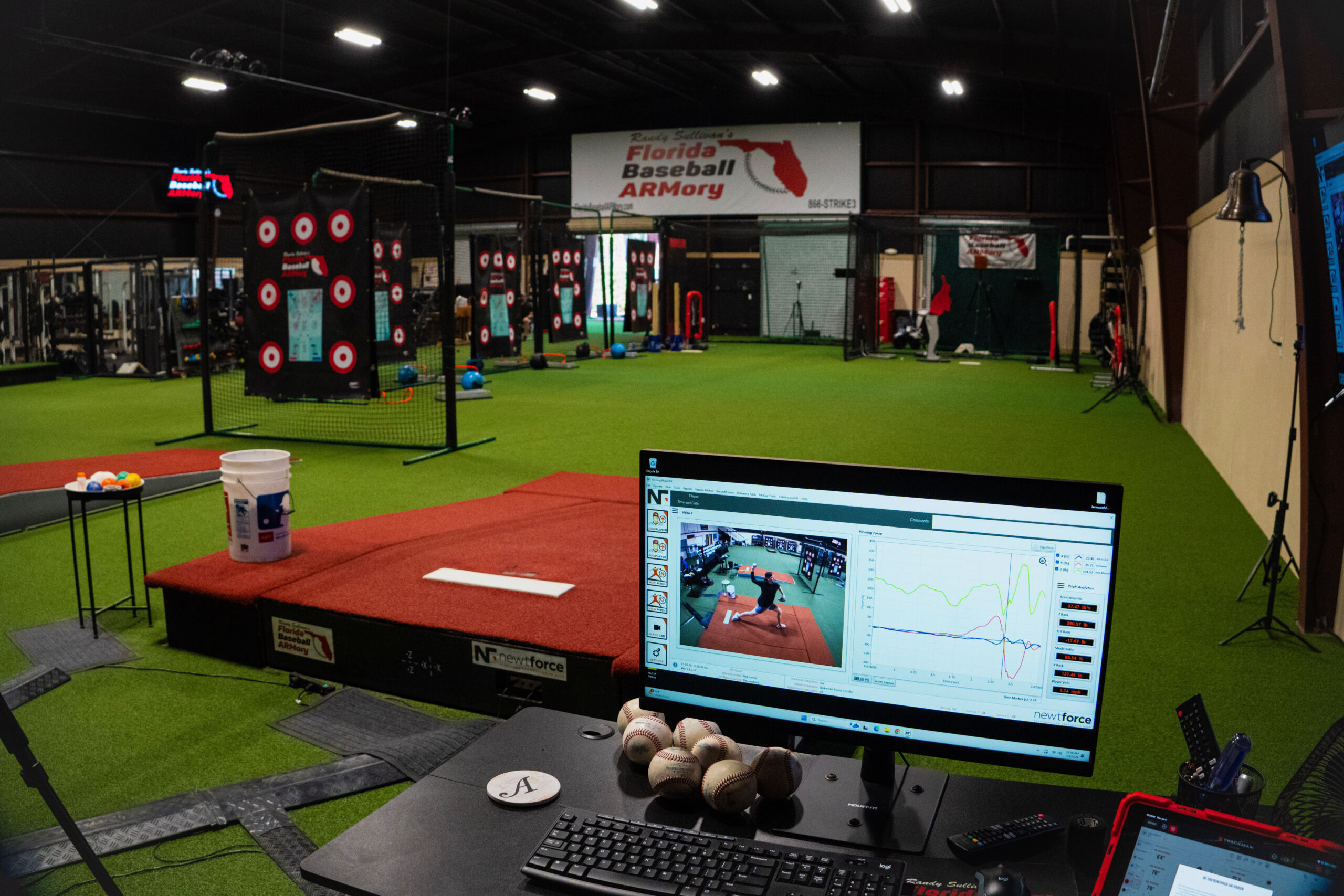
Our NewtForce mound told the story immediately. His impulse trace revealed a quad-dominant first move that was pushing him across his body instead of driving him toward the plate. The force spike was sharp and early, peaking at only 29 percent of his body weight — far below what an efficient mover should produce.
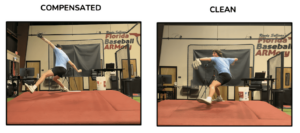
Motion capture and high-speed video filled in the rest. His trunk was tilted. His lumbar spine was hyper-arched. These weren’t cosmetic issues. They were energy leaks. Every ounce of force his legs generated was being dispersed through a trunk that couldn’t transfer it efficiently.
TrackMan confirmed the downstream effects: elevated release point, reduced extension, and a cutting fastball shape that lacked the carry and life that college coaches look for. His arm wasn’t the problem. His organization was the problem. And no amount of “throw harder” was going to fix it.
We Didn’t Chase Force. We Restructured the Environment.
This is where our approach at The Florida Baseball ARMory diverges from everything else in the industry. We didn't give him a velocity program. We didn't hand him a heavier ball. We didn't tell him to push off harder or stride longer or be more aggressive.
Instead, we applied a constraints-led progression. AquaBall throws that forced his body to organize co-contraction differently. Gym-based perturbation drills that challenged his trunk stability under dynamic load. Environmental manipulations that guided his body toward discovering better solutions for chest-out rotation and abdominal slack regulation.
We didn't teach him how to move. We created conditions where his body taught itself. This is the foundation of ecological dynamics — the idea that skill emerges from the dynamic interaction between the athlete, the task, and the environment, not from copying positions off a whiteboard.
His body, freed from the compensations that had been stealing his energy for years, began to self-organize into more efficient patterns. Force that had been leaking through his trunk started flowing cleanly through the chain. Timing that had been compressed started finding its natural rhythm.
The Results
Within six weeks, his average fastball climbed to 87 mph. His peak touched 89. That's a 4-to-6 mph gain — not from trying harder, but from moving smarter.
But the velocity was only part of the story. His delivery looked freer. His arm felt better. His recovery improved. His confidence came back. And a video of his bullpen, posted online, caught the attention of a college recruiter who quickly offered him an official visit.
That's the difference between chasing a number and building a system. The number is fragile — it can flash once and disappear. The system is durable — it produces that number repeatedly, safely, under pressure.
Why This Works (And Why ‘Throw Harder' Doesn't)
Agresta and colleagues used wearable inertial sensors to track segmental motion in live bullpens and found that ball velocity was closely associated with measures reflecting proximal-to-distal coordination across the pelvis, trunk, upper arm, and forearm — not with any single isolated segment variable. Velocity doesn't come from the arm. It comes from the chain. And the chain produces speed only when timing and organization allow it.
When you tell a pitcher to “throw harder,” you're asking the arm to manufacture speed on its own. When you build the coordination infrastructure — stable ground forces, efficient trunk transfer, clean sequencing — velocity emerges as the natural consequence of the system working as designed.
Leenen and colleagues tested this directly by restricting pelvic-trunk mobility in elite adolescent pitchers. When the natural sequencing was disrupted, ball speed declined. Not because the arm got weaker. Because the system couldn't coordinate energy transfer. That's the proof: velocity is a system property, not an arm property.
At The Florida Baseball ARMory, we've watched this play out over 500 times. Pitchers who were stuck at 82 break through to 88. Kids sitting at 87 touch 93. Not because we told them to throw harder. Because we built the movement system that made higher velocity inevitable.oyo88
If your son is stuck and nothing seems to move the needle, the answer isn't more effort. It's better organization. Call us at 866-787-4533 or register for a SAVAGE Summer Program at floridabaseballarmory.com. We don't chase velocity. We build the system that produces it.
References:
- Agresta C, Freehill MT, Nakamura B, Guadagnino S, Cain SM. Using Sensors for Player Development: Assessing Biomechanical Factors Related to Pitch Command and Velocity. Sensors (Basel). 2022 Nov 4;22(21):8488. doi: 10.3390/s22218488. PMID: 36366188; PMCID: PMC9655623.
- Leenen, A. J. R., Von Elsner, H., van der Graaff, D., Strueder, H. K., & Lambrecht, K. (2022). Fastball pitching performance only slightly decreases after experimentally impeding pelvic-trunk mobility in elite adolescent baseball pitchers. Frontiers in Sports and Active Living, 4, 1044616. https://doi.org/10.3389/fspor.2022.1044616
About the Author:

Randy Sullivan, MPT, CSCS
CEO, Florida Baseball ARMory
Our founder and CEO, Randy Sullivan wears a bunch of hats: Physical Therapist, Baseball Instructor, Certified Strength & Conditioning Specialist, Paid Player Development Consultant to MLB teams, Public Speaker and of course an Author.