

Walk into almost any bullpen at the beginning of the summer and you’ll see the same scene.
Radar gun behind the catcher. Weighted balls lined up like candy. A coach shouting, “Let it eat!”
For a few weeks, the readings climb. 87 becomes 89. 89 becomes 91. Social media posts go up. High‑five emojis fly.
Then, right on schedule—about six or seven weeks in—the story changes.
The velo plateaus or drops. The arm feels heavy. Command frays. Recovery stretches from a day to three. The athlete is suddenly fighting his own body.
This is the paradox of intent‑only, effort‑first training: it works…until it doesn’t.
The Velocity Trap: Chasing Energy in the Wrong Places
Most of the pitchers we see are not short on effort. They’re short on efficiency. They’ve been sold the idea that more intent is always the answer, so they go searching for energy in the only way they know how—muscle harder, move faster, add more load.
On paper, it makes sense:
- Throw heavier balls, fire the nervous system, get more layback, more elastic recoil, more velo.
- Run and gun from 20–30 feet back, sprint into the throw, and rip it as hard as possible.
And for a while, it “works.”
Research and real‑world experience both show that aggressive weighted ball protocols can spike velocity in a matter of weeks. Some studies report gains of 2–5 mph in six weeks, especially when extreme weights and max‑effort throws are used.
But those gains aren’t free.
- Overload balls and high‑intent run‑and‑guns significantly increase elbow varus torque, especially on flat ground.
- Six‑week weighted ball programs have produced injury rates north of 20 percent in the training group, compared to 0 percent in controls who only did strength and traditional throwing.
- Shoulder external rotation (layback) can jump 8–20 degrees in a matter of days or weeks—not because the system is stronger, but because proprioceptive brakes have been bypassed.
Those early velo gains are often nothing more than the body allowing you to borrow from its long‑term protection plan.
Survival Always Wins: Why Short‑Term Gains Fade
Your body is not designed for performance first.
It is designed for survival.
When tissue stress exceeds its ability to recover, the nervous system quietly hits the brakes long before you feel pain. Velo dips, command erodes, and recovery lags—all as a protective response.
That’s why:
- Velocity can drop 1–3 mph even while an athlete is “working harder than ever.” The system is self‑throttling output to stay safe.
- Command suddenly goes shaky—arm‑side misses, pull‑yanks, inconsistent release—because the body is reorganizing movement on the fly to avoid a stress point.
- Recovery stretches from 24–48 hours to 72–96 hours or more; the arm feels perpetually dead or “just not right.”
In the short term, under emergency conditions, the nervous system will let you do some crazy things.
It can temporarily suppress proprioceptive reflexes, allow more layback, tolerate more torque, and access strength you didn’t know you had. That’s how a mother can lift a car off a trapped child—once.
But once the body figures out this isn’t a one‑off crisis—that you intend to live in this red‑zone state, day after day—it changes the rules. Around week five to seven of an all‑gas, no‑brakes velocity phase, you can almost feel the switch flip:
- Protective mechanisms re‑engage.
- Output is dialed down.
- Efficiency, not effort, becomes the limiting factor.
You can’t “out‑tough” biology. Over time, survival always trumps performance.
The Four Minimums: Your Body’s Built‑In Laziness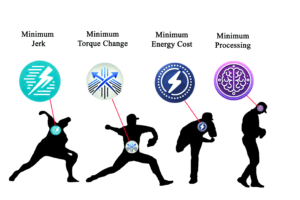
Movement science gives us a clear window into why this happens.
Frans Bosch describes four simple rules the body follows when it self‑organizes movement, which we call The Four Minimums:
- Minimum jerk – Minimize abrupt changes in acceleration.
- Minimum torque change – Minimize rapid swings in joint forces.
- Minimum processing – Minimize cognitive load; keep movement automatic.
- Minimum cost – Minimize energy expenditure.
Translated: every system, from a school of fish to a 17‑year‑old on a mound, is trying to do the job with as little stress, noise, and energy drain as possible.
When you pile high‑intent, poorly organized effort on top of that system, a few things happen:
- The body will still hit the global goal (throw hard), but it will choose whatever pattern feels most survivable and least costly in the moment—even if that pattern is mechanically terrible.
- It will drift toward passive attractors that lean on ligaments, labrum, and capsule instead of active muscular control: excessive layback, lumbar over‑extension, inverted‑W positions, linear deceleration, etc.
- Under chronic stress, it will eventually redefine “safe” as “less speed, less load,” and throttle back your velocity to protect itself.
Effort can never permanently override these rules.
It can only borrow against them—for a while.
All Effort, No Efficiency: What It Looks Like on the Mound
You’ve seen these guys:
- Weight‑room monsters who crush pull‑downs and plyos but can’t carry their bullpen velo into the fifth inning.
- Social‑media darlings who post 98‑mph run‑and‑guns in January and throw 90–92 in games by May, if they’re still healthy.
- Pitchers who PR their velocity in a six‑week program, then spend the next six months battling dead arm, erratic command, or worse, injury.
The common thread isn’t lack of work. It’s lack of movement literacy.
They’re chasing energy in the wrong places:
- Stealing “free” layback from passive structures instead of earning it through hip hinge, hip lock, pelvic control, and thoracic organization.
- Muscling into ball speed instead of improving how ground reaction forces travel through the pelvis, trunk, and arm in a proximal‑to‑distal sequence.
- Drilling mechanics in isolation instead of training in representative, variable environments that force the body to self‑organize efficient solutions.
In our lab, we’ve seen the other side of the story thousands of times.
When we stabilize the right attractors—back‑leg hinge and rotation, hip lock, pelvic closure, trunk slack regulation, scapular rhythm, deceleration pattern—pitchers gain 3–5 mph, sharpen command, and feel better doing it, often with little or no weighted ball use https://molpromline.ru/katalog/
Effort didn’t change. Efficiency did.
Movement Literacy: The Missing Ingredient
Movement literacy is the ability to feel, adapt, and organize your body in real time, under real game‑like constraints.
It’s what allows a pitcher to:
- Find stable attractors on every pitch, even as intent, fatigue, mound, and context change.
- Adjust to micro‑errors in timing or position without losing velocity or command.
- Maintain performance when the nervous system is tired and the stakes are high.
Building movement literacy is not simple. It requires:
- A deep understanding of human movement—anatomy, biomechanics, ecological dynamics, and dynamic systems theory.
- Years of coaching experience reading how those principles show up in real athletes under real stress.
- Technology that connects the tech to the tissue:
- Ground force data to see how you interact with the mound.
- Motion capture to reveal where and how you create or lose stability.
- Ball‑flight metrics to map how your movement shows up in velocity, spin, and command.
That’s exactly what our Attractor Code Lab and SAVAGE Training were built to do.
We don’t just chase numbers. We teach your body a new language and then test its fluency every day.
Why Cookie‑Cutter Velocity Programs Fail You
Here’s the uncomfortable truth: the villain in this story isn’t weighted balls, radar guns, or high intent.
The villain is bad training—programs that:
- Treat every pitcher like the same body with the same tissue history and the same movement profile.
- Add aggressive tools before the athlete has the hardware and movement stability to handle them.
- Worship short‑term radar gains and ignore the early warning signs that the body is quietly hitting the brakes.
These programs follow a predictable arc:
- Weeks 1–2: Max‑effort throws begin. Protective sensors are muted. Velo jumps. Everyone celebrates.
- Weeks 3–4: Tissue stress accumulates. Patterns shift toward passive attractors. The athlete “feels a little tight,” but powers through.
- Weeks 5–6: The nervous system realizes this is the new normal. Survival mode kicks in. Output quietly drops. Command frays. Recovery costs climb.
- Week 7 and beyond: Dead arm, “random” elbow or shoulder pain, or a mysterious loss of feel. The athlete thinks he just needs more intent. The system is trying to save him from himself.
That’s “all effort, no efficiency” in a nutshell. It’s not a pathway to sustainable velocity. It’s a slow‑motion hijacking of a career.
Building on Rock, Not Sand: How We Do It at The ARMory
At The Florida Baseball ARMory, we refuse to build performance on top of unstable movement. We start with the foundation and work up.
Every athlete who comes into our SAVAGE Summer Training Program goes through a comprehensive process before we ever talk about weighted balls or high‑intent throwing:
- Full system assessment
- Arm health and pain/injury history.
- Structural and mobility screen—what hardware are we working with?
- Movement analysis across all key attractors: rotation around the hip, hip lock, pelvic closure, trunk control, shoulder and elbow deceleration.
- Integrated Attractor Code Lab session
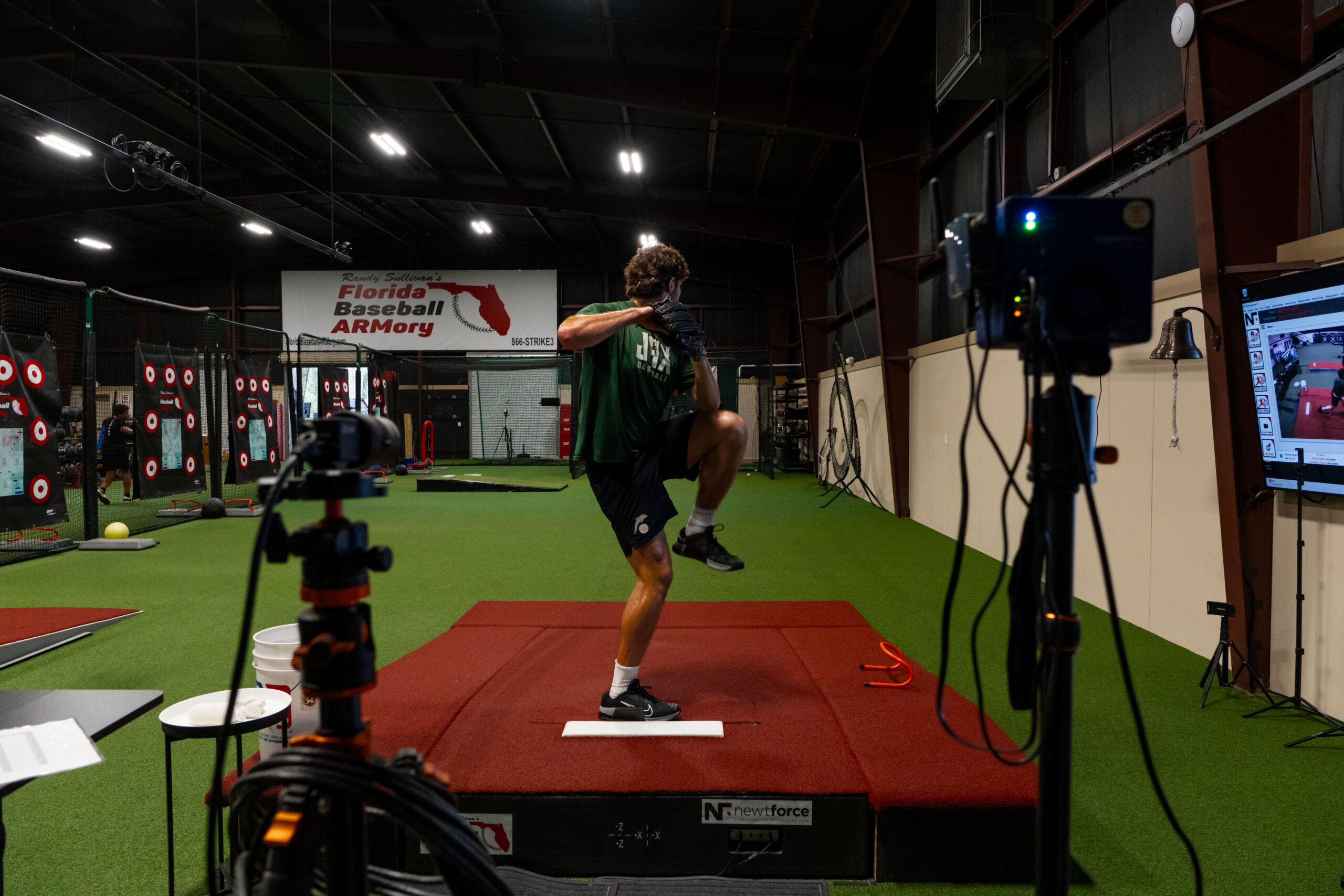
- Ground reaction forces from our sensored mound (Newtforce) to see how and when you create impulse.
- Markerless motion capture to map kinematics in 3D.
- Ball‑flight data (velocity, spin, movement, release) to link movement to outcome.
- Individualized plan—movement first
- We identify which attractors are stable, which are shaky, and which are outright liabilities.
- We design constraint‑led drills, variable loading, and intent progressions specific to you—not the guy you follow on Instagram.
- Selective use of tools
- Only 10–15 percent of our athletes ever touch weighted balls, and only when they meet strict criteria: physical maturity, stable attractor profile, a safe on‑ramp, a performance plateau, and real‑time expert supervision.
- When we do use them, it’s in a narrow 4–7 oz range, with controlled variability and constant monitoring—not 2–32 oz chaos.
The result:
- Athletes add sustainable velocity by improving how they move, not just how hard they try.
- Command improves as a natural consequence of better organization.
- Arms feel better. Recovery tightens. Careers lengthen instead of shortening.
This isn’t theory. We’ve done it with thousands of pitchers—from youth arms to big leaguers.
Your SAVAGE Summer: What’s at Stake
Right now, you stand at a fork in the road.
One path is the “all effort, no efficiency” route:
- Another off‑the‑shelf velocity program built for “average.”
- More random max‑intent days stacked on a tired system.
- More chasing numbers without knowing what your body is sacrificing to get them.
The likely outcomes over the next 6–12 months are:
- A brief bump in velo, followed by a plateau or drop as survival mechanisms kick in.
- Increasing frustration as command, feel, or recovery go sideways at the worst possible time.
- Higher risk of the kind of injury that doesn’t just cost a season—it changes the entire trajectory of your career.
The other path is harder at first, but it’s the only one that pays you back for the rest of your career:
You build your gains on the foundation of quality, efficient movement.
You become literate in your own movement system.
You stop guessing and start training with a plan rooted in science and written specifically for you.
That’s what our SAVAGE Summer Training Program is for.
Over 2–10 weeks in Lakeland, you’ll train 5 days a week in a fully integrated environment: individualized throwing, strength, mobility, arm care, and “Broga,” all wrapped around your unique attractor profile and goals.
You’re the hero of that story—the one who has to do the work, make the throws, and step on the mound when it counts.
We’re the guide.
We bring the map, the lab, the movement literacy, and the thousands of case studies that say, “There is a better way—and here’s what it looks like.”
The Next Step (Before April 15)
If you’re serious about chasing velocity the right way—without sacrificing your arm, your command, or your future—now is the window.
Early‑bird registration for SAVAGE Summer Training is open now at floridabaseballarmory.com/summer, and the early‑bird discount expires on April 15.
Between now and then, you have a choice:
- Keep stacking effort on top of shaky movement and hope your body doesn’t collect the bill.
- Or invest this summer in becoming the kind of efficient, adaptable, durable mover whose gains not only show up, but stay.
If you’re ready to stop living in “all effort, no efficiency,” this is your invitation.
Will you spend another year chasing short‑term velocity—or finally build a foundation strong enough to carry you where you want to go?
About the Author:

Randy Sullivan, MPT, CSCS
CEO, Florida Baseball ARMory
Our founder and CEO, Randy Sullivan wears a bunch of hats: Physical Therapist, Baseball Instructor, Certified Strength & Conditioning Specialist, Paid Player Development Consultant to MLB teams, Public Speaker and of course an Author.