

THE FLORIDA BASEBALL ARMORY
We Don't Guess. We Know.
Why Elite Arm Development Starts With a Diagnosis, Not a Program.
SAVAGE Summer Training Program | The Florida Baseball ARMory
There is a moment every physical therapist knows.
A patient walks through the clinic door, limping, guarding, compensating. You've seen the X-ray. You've read the referral. Maybe you've even heard a colleague's theory about what's wrong. And in that moment, the most dangerous thing you can do (the thing that would get your license revoked, your patient injured further, and your career ended) is to immediately start treating.
Because you don't know yet.
You think you know. You have a hunch. But hunches are not diagnoses. And in medicine, as in arm development, hunches are where careers go to die.
The Villain Is the One-Size-Fits-All Program
Here's what's happening to young pitchers across the country right now.
A kid wants to add velocity. His coach watches him throw for five minutes, maybe pulls up a YouTube video about hip-to-shoulder separation, maybe buys a subscription to some app with a “biomechanical algorithm.” Then he hands the kid a 10-week weighted ball program that was designed for someone else, based on averages that don't describe any individual human being who has ever lived, and tells him to trust the process.
Three weeks in, the kid's elbow is barking. Six weeks in, he's shut down. Eight weeks in, he's sitting in an orthopedic surgeon's waiting room, wondering what went wrong.
What went wrong was the first decision: the decision to skip the evaluation.
No medical history. No pain audit. No movement assessment. No understanding of how this specific athlete's nervous system has organized itself to produce movement. No data. Just a template and a prayer.
In a hospital, that's called malpractice. In baseball, we just call it the industry standard. That ends here.
Your Arm Deserves a Diagnosis Before It Gets a Prescription
Think about what happens when you walk into a world-class medical facility with a serious problem.
The physician doesn't walk in, glance at you, and write a prescription. She sits down. She asks about your history. She reviews your records. She runs labs, orders imaging, conducts a physical examination. She gathers data from multiple independent sources, and then she watches what happens when those data points converge. One of my professors at physical therapy school called it raising your index of suspicion. When the patient history, the clinical exam, the imaging, and the functional testing all point to the same conclusion, your confidence in your diagnosis rises with it. Only then do you design a treatment plan.
The treatment plan has specific, measurable goals. It has actionable interventions. It has a built-in reassessment protocol, because the best clinicians know that the map is not the territory. You apply the treatment, measure the response, and adjust.
That is not a radical idea. That is just good medicine.
And that is exactly how we develop pitchers at The Florida Baseball ARMory.
What a Real Evaluation Looks Like
Before any athlete at The ARMory throws a single training pitch under our guidance, we build a complete picture of who they are, where they've been, and where they need to go.
Subjective Intake
Medical and injury history. Full pain audit. Readiness assessment. Recovery evaluation. Performance history. Individual goals. We want to know about every arm issue you've ever had, every surgery, every dead-arm stretch that scared you mid-season. We want to understand your performance history — velocity, secondary stuff, command late in games. We want to hear your individual goals, because developing a pitcher who wants to throw 98 mph in the big leagues requires an entirely different approach than developing a high school sophomore who wants to make his JV squad.
The Attractor Code Lab
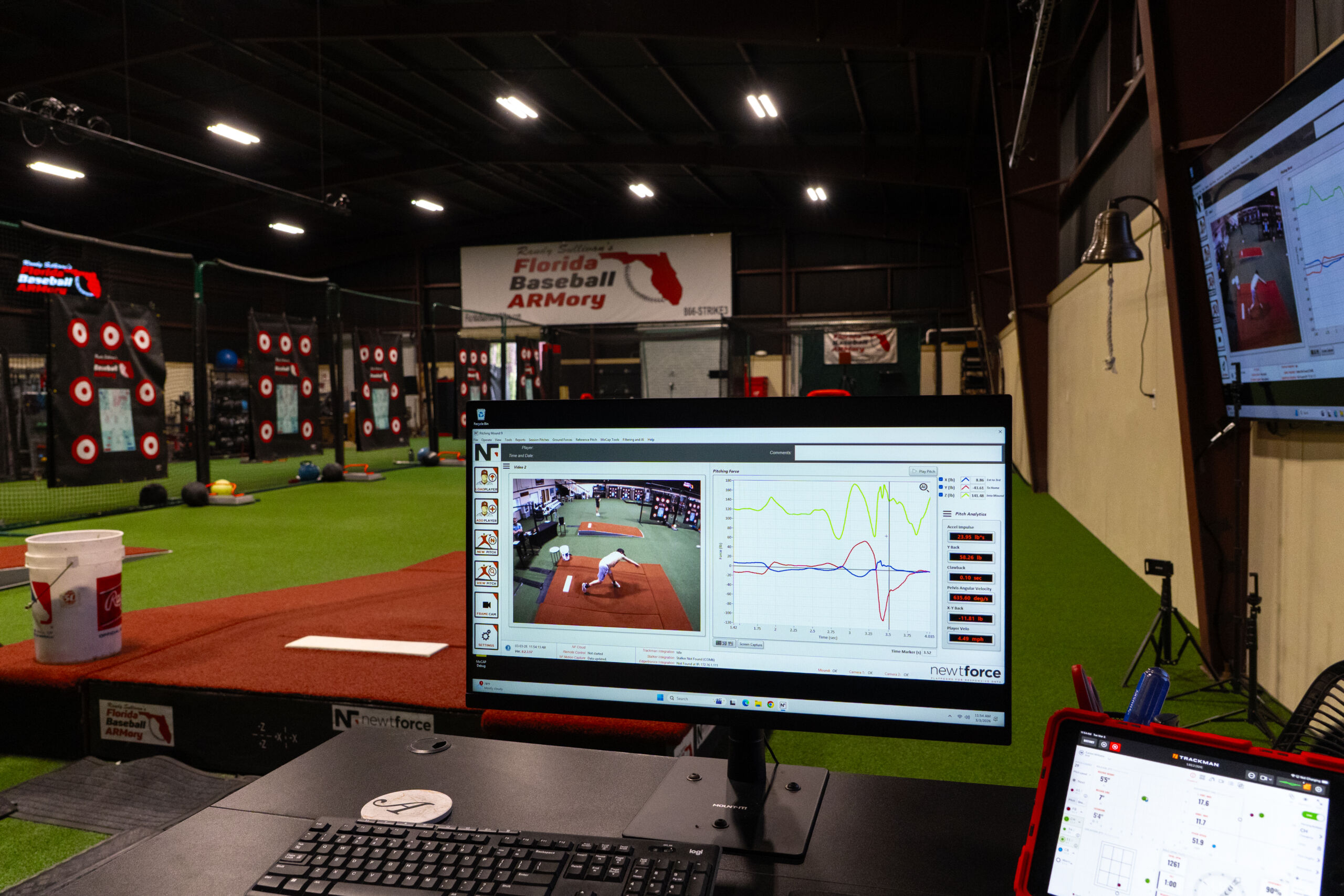
Our objective assessment goes beyond anything you've experienced. We measure ground force — how you interact with and drive off the mound. We use motion capture to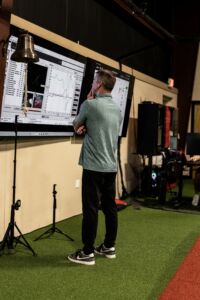 map the kinematic chain from the ground up. We bring in TrackMan ball flight data so we're not guessing about spin rate, spin efficiency, induced vertical break, or horizontal movement. We capture everything on high-speed video at 300-900 frames per second.
But here's what separates The ARMory from every other facility doing “technology-based assessments.”
We don't read your data through a flawed biomechanical checklist. We don't have a “model pitcher” we're trying to sculpt you into. We look at your data through the lens of Ecological Dynamics — a leading-edge motor control and skill acquisition framework that treats the human body the way it actually works: as a complex, adaptive, self-organizing system embedded in a specific environment, with a specific task to accomplish.
Human movement, especially the ballistic, high-speed, supremely skilled movement of pitching, is not a mechanical problem. It is a biological problem. A neurological problem. A perceptual problem. And it requires a biological, neurological, perceptual solution.
Simplicity on the Far Side of Complexity
Oliver Wendell Holmes once said: “I would not give a fig for the simplicity this side of complexity, but I would give my life for the simplicity on the other side of complexity.”
That is the ARMory philosophy in one sentence.
We could give you a five-point mechanical checklist and tell you to drill it until it's automatic. That's the simple side of complexity. It's comfortable. It's marketable. And it produces mediocre, fragile performers who fall apart the moment the environment doesn't cooperate.
We go through the complexity. We gather all the data. We raise our index of suspicion. We identify your attractors — the universal movement principles that govern efficient, powerful, healthy throwing — and we design training experiences that allow your nervous system to self-organize around those principles.
The result is a pitcher who throws harder, moves better, commands the strike zone, and generates nastier secondary stuff — not because he memorized someone else's mechanics, but because his entire movement system has reorganized around a higher level of performance. And because it's genuinely his, it doesn't evaporate under pressure.
That's the difference between a borrowed technique and owned mastery.
The Stakes Could Not Be Higher
You already know what's at risk.
For the high school athlete: a scholarship, a draft pick, a future in the game. For the college arm: a professional career, four years of work crystallizing into one showcased summer. For the professional: a roster spot, a contract, the livelihood you've sacrificed a decade to earn.
We've seen what happens when athletes spend another off-season in the wrong program. Stalled velocity. An elbow that barks in August every year, right when it matters most. UCL surgeries that didn't have to happen. Guys who plateau at 85 mph for three straight years because no one ever looked at what their ground force actually looked like, or addressed the old ankle injury their nervous system has been compensating around for years.
We've also seen what happens when they come to us first.
This Is What Transformation Looks Like
Players who come through The ARMory's SAVAGE Summer Training Program don't just add a few ticks of velocity. They develop a relationship with their own movement that most pitchers never achieve in a lifetime in the game. They understand why they move the way they move. They know how to self-correct under pressure, how to maintain their arm across a full start, how to protect their health without sacrificing performance.
They throw harder. They throw with more life on their fastball. They develop secondary pitches with genuine late movement. They throw strikes without pattern predictability. They feel good in all year long.
They carry The ARMory's approach with them for the rest of their careers. We build elite performers one day, one decision at a time.
SAVAGE Summer 2026: Your Window Is Open. Not for Long.
Program Dates: June 1 – August 14 | Early arrivals & late summer extensions welcome.
Sessions: 8:00am – 12:00pm | 12:00pm – 4:00pm
EARLY BIRD DEADLINE: APRIL 15TH Register before April 15 — lock in Early Bird pricing, your choice of session, and guaranteed dates.
Register before April 15th and you get first choice of AM or PM session. Your dates and your slot are guaranteed. After April 15th, you register into whatever space remains — if any space remains. Sessions fill. They always do.
This is not a decision to make in May. The athletes who change their careers are the ones who made a decision in March.
The ARMory Is Your Guide
You are the hero of this story. You are the one who has put in the work, endured the grind, and refused to accept that mediocrity is your ceiling.
We are not here to hand you a program. We are here to give you a map — built entirely from your own data, your own movement, your own potential — and to walk with you every step of the way toward the pitcher you are capable of being.
You don't need more guesswork. You don't need another weighted ball protocol that was designed for someone who isn't you. You need a diagnosis. You need a plan. You need someone who uses the full depth of the science — and the full breadth of their experience — to make decisions about your development that are specific, measurable, and built for you. https://dph.stamforduniversity.edu.bd/
That is what we do at The Florida Baseball ARMory.
REGISTER NOW HERE — CLAIM YOUR EARLY BIRD SPOT BEFORE APRIL 15TH floridasarmory.com | SAVAGE Summer starts June 1st We don't guess. We diagnose. We develop. Come find out what you're actually capable of.
The Florida Baseball ARMory | Attractor Code Lab | SAVAGE Summer Training Program
Sessions: 8am–12pm | 12pm–4pm | June 1 – August 14 | Early Bird Ends April 15
About the Author:

Randy Sullivan, MPT, CSCS
CEO, Florida Baseball ARMory
Our founder and CEO, Randy Sullivan wears a bunch of hats: Physical Therapist, Baseball Instructor, Certified Strength & Conditioning Specialist, Paid Player Development Consultant to MLB teams, Public Speaker and of course an Author.