


Everywhere you look in baseball right now, somebody is bragging about being data-driven. Rapsodo and TrackMan screens, motion capture setups, biomechanics reports 20 pages thick… if you don't speak in graphs and Greek letters, you're “behind.”
On the surface, it sounds great. Numbers feel objective. Charts feel scientific. Biomechanics sounds smart.
But here's the problem: most of what's being sold as “data-driven biomechanics” is built on two bad assumptions:
- That your body behaves like a robot made of hinges and rods.
- That if you collect enough numbers, simple cause-and-effect rules will magically appear.
Neither of those is true for an actual living pitcher.
Dead guys and robots
A lot of the “gold standard” elbow-stress data comes from cadaver elbows. Dead tissue. No muscular system actively protecting the joint. No nervous system coordinating anything.
Those studies tell us a UCL tears somewhere around 32–35 Nm in a lab, while in live pitchers, calculated torque can be 70 Nm or more on a given pitch. Nobody can explain how that makes sense, because the underlying assumption is wrong: a live arm is not a dead ligament in a vise.
Same thing with many motion-capture models. They assume you're basically a metal stick figure obeying simple Newtonian rules, and that if we just look at enough joint angles and torques, we'll find the one magic position that guarantees velocity and health.
As Frans Bosch said, “There seems to be very little bio in biomechanics.”
The fact that you're alive ruins the neat little equations.
Your muscles co-contract. Your fascia stores and releases energy. Your nervous system is constantly reorganizing movement on the fly. Those “internal” adjustments don't show up cleanly in the sensor data, but they matter more than a single angle on a PDF.
When you build giant “normative databases” on top of those flawed assumptions, you don't solve the problem—you amplify the iwa error. It's like making a huge map using a bad ruler. The bigger the map, the more wrong it gets.
Complex system, not simple machine
Your delivery isn't a Lego model; it's a storm system.
- The weather
- An economy
- An ecosystem
- A human body
All of those are complex systems. Change one variable and a dozen others reorganize to keep the whole thing from flying apart. That's how your pitching motion works too.
Everyone wants linear rules:
- “If you put your arm here, velo goes up.”
- “If you land like this, your elbow will be safe.”
But in a complex system, linear cause-and-effect mostly breaks down. You can't fix command by chasing a single joint angle any more than you can fix the stock market with one interest-rate tweak.
So, do we throw the tech away? No. We just have to use it differently.
Attractors: the code under the chaos
When I wrote The Attractor Code, I realized I had two options:
- Hire a biomechanist, then try to teach them ecological dynamics and real-world pitching.
- Or become the biomechanics guy myself and write the code I wish we'd had all along.
Option two was faster and more efficient. So we got the Newtforce Integrated Lab and the software stack to go with it.
Here's the key idea we use at The Florida Baseball ARMory:
We're not hunting for “pretty mechanics.” We're mapping attractors.
An attractor is not:
- A pose
- An angle
- A frozen checkpoint
An attractor is a stable movement solution your body keeps coming back to when things get fast, heavy, and stressful. It's the underlying pattern that lets you throw hard, on time, and without blowing up—even while the visible motion changes from pitch to pitch.
Some examples from our 9-attractor map:
- Rotation around the hip
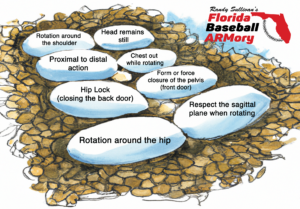
- Hip lock at toe-off
- Pelvic closure (front-leg brake)
- Abdominal slack regulation
- Proximal-to-distal whip
- Rotation around the shoulder
- Head stillness
These are the “big rocks,” not the pebbles. When they're stable, you can tolerate a lot of harmless variability in the little stuff and still throw absolute nails.
What we actually do with the data
Most places use tech as a scoreboard.
- “Here's your velo.”
- “Here are your joint torques.”
- “Here's a list of 37 angles you're ‘off' on.”
Then they spit out a generic drill list and hope something sticks.
We use tech as an x-ray on your attractors. The stack is synchronized on every pitch:
- Newtforce mound: how you talk to the ground (force into and out of the rubber and front leg).
- Markerless motion capture: how segments actually organize and hand off energy through time.
- TrackMan: what the ball says about the whole pattern—velo, release, spin, movement, tunnel.
- High-speed video: what trained eyes see in shapes, timing, and rhythm.https://bcfma.com/forms/
No single metric “proves” anything. But when all four layers point to the same coordination issue, the picture is crystal clear.
Example:
- Your front-leg force traces show a late, sloppy brake.
- Motion-capture shows your pelvis never really decelerates before your trunk starts to fire.
- TrackMan shows your release point and spin axis wandering all over the place.
- Video shows your head yanking and your front knee snapping straight.
That's not “random inconsistency.” That's one unstable attractor—pelvic closure—showing up four different ways. Fix the attractor and the “mechanical flaws” resolve themselves.
Cracking the code: finding your leaks in seconds
The big breakthrough for us was speed.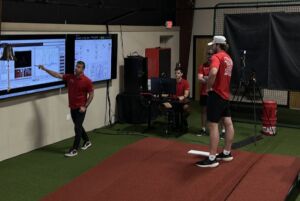
The Attractor Code is written so that within seconds of each pitch, we can see:
- Which attractors are rock solid.
- Which ones are softening.
- Exactly where energy is leaking out of the chain.
We build a 3D Attractor Profile for you—movement expression, measurable consistency, and how your pattern holds up when we change the constraints (tempo, fatigue, intent, implements).
From there, we stop guessing.
- If rotation around the hip is unstable, we don't waste time cueing your arm path.
- If head stillness is falling apart under game intent, we don't spend the week arguing about your stride length.
- If your proximal-to-distal sequencing is jammed, we don't tell you to “just get more separation.”
Instead, we design constraints—targeted drill environments that make the stable pattern the easy solution and the unstable pattern expensive. The work is hard, but the logic is simple: organize the system, and the stats follow.
We've watched guys:
- Gain velo without “trying harder” because the kinetic wave finally lines up.
- Tighten release clusters by 30% just by stabilizing one upstream attractor.
- See nagging arm pain resolve when the real “gang leader” turned out to be a leaky back-hip hinge—not the elbow.
That's the difference between throwing drills at a problem and understanding the code underneath the chaos.
Why this matters to you
If you're a high school or college pitcher (or a parent), you're stuck in the middle of all this.
One facility tells you your elbow torque is too high.
Another says your arm path is “clean,” so you're fine.
A third hands you a sheet of comparative averages and calls you inefficient.
Meanwhile:
- Your velo bounces.
- Your command disappears under pressure.
- Your arm feels worse, not better.
You don't need more charts. You need someone who can read what the data actually means to a living, adapting body—and then coach you in plain English.
That's what we built the Attractor Code Lab to do.
We don't care how “data-driven” something looks on Instagram. We care whether your attractors are stable enough to:
- Survive a long season.
- Hold velocity when the adrenaline spikes.
- Keep your elbow and shoulder out of the surgeon's office.
And we can see where you're leaking energy in a single session, then prove the fix in the same pen.
Your next step
If this resonates—if you're tired of dead-guy assumptions and robot models being applied to your very live arm—here's how to plug into what we're doing:
- SAVAGE Summer Training – Our full-scale, in-house program. Live in the building, hammer your attractors, and leave with a different body of work.
- One-on-One Precision Strike – Fly in, get a deep-dive attractor assessment and a laser-targeted plan built around your stability map.
- SAVAGE Satellite Program – Can't live in Florida? We'll build and oversee a remote plan using the same attractor lens and give you ongoing feedback.
- Or Call Us at 866-787-4533 for a customized plan that meets your needs precisely.
If you're ready to stop chasing random “mechanical tips” and start building a delivery that holds under real-game chaos, pick the option that fits you and get on the schedule.https://cpgcre.com/services/
Bring your questions. Bring your numbers. Bring your doubts.
We'll show you where the leaks really are—and how to fix them for good.
About the Author:

Randy Sullivan, MPT, CSCS
CEO, Florida Baseball ARMory
Our founder and CEO, Randy Sullivan wears a bunch of hats: Physical Therapist, Baseball Instructor, Certified Strength & Conditioning Specialist, Paid Player Development Consultant to MLB teams, Public Speaker and of course an Author.