

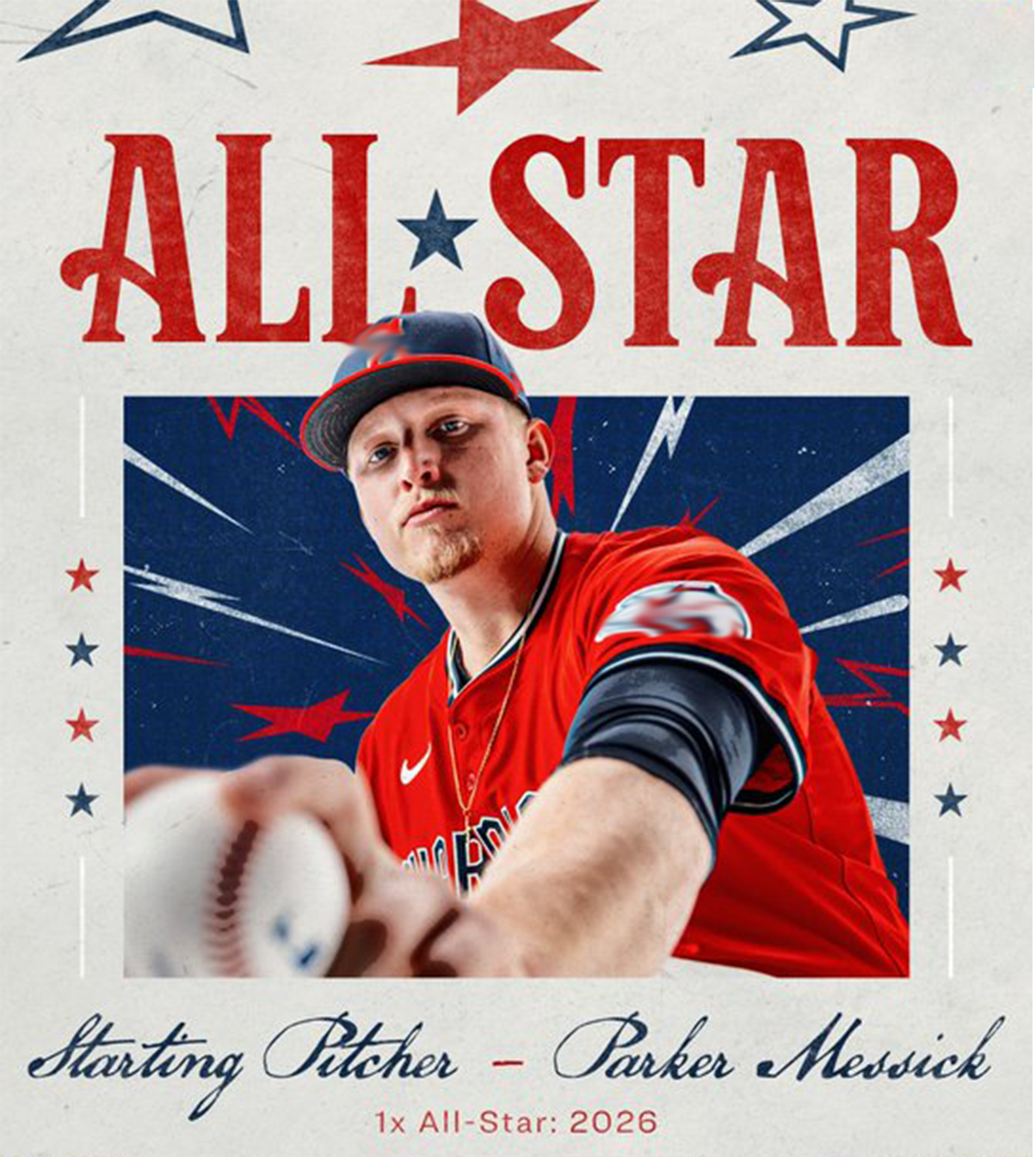
This weekend, in Philadelphia, Parker Messick walks into Citizens Bank Park as a Major League All-Star.
Let that sit for a second. Then let me take you back about a dozen years, to a 900 square foot office in a strip mall, where a seventh grader was throwing into a net while I stood behind him with a clipboard.
That was Parker. That was us.
A few years earlier, we had moved. And when I say moved, I mean we had graduated from the bed of my pickup truck. That is not a figure of speech. In the earliest days of the Florida Baseball ARMory, my facility was whatever I could fit in the back of my truck and haul to a field. The 900 square foot office in that strip mall felt like Yankee Stadium to us. We had a little space, a net, some weighted balls, a radar gun I mostly ignored, and a stack of ideas about how the human body actually learns to throw a baseball.
And we had a chubby kid from Plant City who could not stop competing.
Here is what I want you to understand before I tell you the rest. Nobody who walked past that strip mall office and glanced through the window would have circled Parker Messick as a future big leaguer. He was not tall. He was not lean. He was not lighting up a gun. If you ran him through the standard prospect filter that our industry loves so much, the one that sorts twelve year olds by height, weight, and velocity, Parker does not make the cut. He gets told to come back when he grows, or when he throws harder, or when he looks the part.
He never looked the part. He just kept becoming an All-Star anyway.
The myth we have been fighting for twenty years
There is a story our sport tells parents, and it is a lie.
The story says velocity is destiny. The story says get the number up, get it up now, get it up by any means, and everything else takes care of itself. The story turns a twelve year old into a lab experiment and a radar gun into a report card. And the story quietly breaks a stunning number of arms every single year, then shrugs and says that is just the cost of doing business.
I have never believed it. Not in the truck, not in the strip mall, not now.
Look at how the scouts describe Parker today, in the middle of an All-Star season. He is not a power arm. He wins with a six pitch mix and a changeup that falls off the table. He commands the strike zone. He reads hitters. He makes an at bat feel like a losing argument. Through his starts this year he owns an ERA under 3.00 and has piled up more innings than any rookie in baseball, and this April he came three outs from throwing a no-hitter.
He does all of that without ever having been the hardest thrower in the room. He was not the hardest thrower in that strip mall.
He is the most skilled.
That distinction is the entire reason the ARMory exists. Velocity is a byproduct of good movement, not a goal you chase with a whip. When you build an athlete who moves well, who solves the problem of throwing a baseball the way his body was designed to solve it, the velocity shows up on its own, and so does the command, and so does the health, and so does the pitch that falls off the table when a big league hitter is sitting dead red. We do not train radar gun readings. We train movement solutions. The gun is a spectator.
Parker is the argument. I do not have to make it for him.
They asked him to throw harder. Watch how he answered.
Here is the part of the story I love the most, because it is the whole ARMory philosophy playing out on a Major League stage.
After Parker made his big league debut last year, Cleveland came to him with a request. They wanted more velocity out of him in the offseason. Now understand, velocity has never been Parker's calling card. He has always been the changeup artist, the command lefty, the pitcher who beats you with feel and deception. Throwing gas was not his identity.
He did not argue. He said OK. And then he spent the entire winter dedicating himself to one thing: becoming a better athlete. Not chasing a radar number with a towel drill. Not maxing out on a machine. Becoming more athletic. Moving better. Getting stronger in the ways that actually transfer to the mound.
Now watch what happened. His fastball averaged 92.8 last year. This season he is living in the mid 90s and touching 96, and in June he ripped off a 97.5, the hardest pitch he has ever thrown as a professional, a full tick past his old best. His peak is up. His average is up. And the payoff is brutal for hitters. Last year they hit .302 against his four seam fastball. This year they are hitting .152 against it.
He did not become a different pitcher. He became a better athlete, and the velocity came along for the ride. That is not a coincidence. That is the entire point. Velocity is a byproduct of good movement. You do not chase the number. You build the athlete, and the number chases you.
Even the writers covering him noticed. They wrote that what we are seeing is not Parker chasing velocity, but a byproduct of the work he has done to sharpen himself as a pitcher. I could not have said it better, and I have been saying it for twenty years.
His relentless work last offseason is a big reason he is standing on an All-Star mound this week. Same kid. Same approach. He just kept becoming.
Every single step
Here is the part that still gets me.
Parker Messick did not show up to us as a finished prospect looking for a tune up. He grew up inside this thing. He was here when we had nothing. He was here as we figured it out. And he stayed.
He was here when he became Florida Mr. Baseball, the single best high school player in the entire state, after a senior year in which he struck out a state leading 125 hitters and posted a 1.06 ERA. That is not a regional honor. That is the whole state of Florida looking at every player it has and pointing at Parker.
He was here when he went to Florida State and turned into a star, ACC Freshman of the Year, ACC Pitcher of the Year, a lefty who made grown men in the best conference in college baseball look overmatched.
He was here when USA Baseball put him on Team USA and let him wear the letters across his chest.
He was here when Cleveland drafted him in the second round, fifty fourth overall.
He was here when he debuted in the big leagues.
And this week, when the best players in the world were handed a ballot and asked who deserved to be an All-Star, they wrote down Parker Messick. Player balloting. Not a popularity contest, not a fan vote, not marketing. His peers, the very hitters he has been carving up all season, looked at what he does and said that guy belongs. He is the first left handed Cleveland starter voted to the All-Star Game since Cliff Lee in 2008.
The pudgy seventh grader from the strip mall got voted in by the best baseball players alive.
I have coached a long time. Moments like this do not get old, and they do not get common. Most careers do not end this way. Most careers end quietly, with a kid who got chewed up chasing a number, or who got told he did not look the part and believed it.
Parker never believed it. And neither did we.
What actually built him
I want to be careful here, because Parker made Parker. The work was his. The stubbornness was his. The faith he keeps thanking on national television is his. No coach gets to stand next to a career like this and take the credit, and I am not going to.
But I will tell you what we gave him, because it is exactly what we give every athlete who walks through our doors, and it is the reason I am writing this instead of just watching the game.
We gave him an environment built on how movement actually works, not on how the industry wishes it worked. We gave him constraints that forced his body to find better solutions instead of drills that forced his body to copy a picture. We gave him a place that measured skill, not just speed. We gave him years, not a weekend gimmick. And we gave him the truth every time, even when the truth was uncomfortable.
That is not a Parker program. That is the program. It is the same thing we hand a seventh grader today that we handed the seventh grader who is pitching in Philadelphia this week.
Your window is open right now
If you are reading this, you probably have a kid who loves this game. Maybe he is not the biggest. Maybe he is not the hardest thrower in his group. Maybe somebody already told him to come back when he grows.
I have heard that story before. I watched where it went.
The window to build a real athlete is not forever, and it is open right now. Not next season. Not when he grows. Now, while he is learning how to move, while the habits are still soft clay instead of dried concrete.
Here is how you step into it with us.
SAVAGE Summer Training is our flagship. It is the deep, immersive block where we build athletes the way we built Parker, over weeks, not hours. If you want the full ARMory, this is it, and summer is here.
SAVAGE Weekend Training Camp is for the family that cannot relocate their life but wants a concentrated, hands-on dose of what we do. You come in, we go to work, you leave with a plan and a body that already moves differently.
Precision Strike One-on-One Session is you, your athlete, and an ARMory coach, no crowd, no waiting your turn. We put every tool we have on one athlete and attack exactly what is holding him back.
SAVAGE Satellite is for the family that lives too far to drive in. We coach your athlete remotely, with real eyes on real film and real programming, the same standard we hold in the building, delivered to wherever you are.
Pick the one that fits your life, and let us go to work.
I cannot promise you an All-Star. Nobody honest can. But I can promise you this. We will not sort your kid by how he looks or how hard he throws today. We will build the athlete underneath, the one the radar gun cannot see, the one who added velocity by becoming a better mover, the one the players themselves voted into an All-Star Game this week.
That kid started as a pudgy seventh grader in a strip mall.
Come find out what your kid can become.
Call us at 866-787-4533 and Amy will get you set up today!
About the Author:

Randy Sullivan, MPT, CSCS
CEO, Florida Baseball ARMory
Our founder and CEO, Randy Sullivan wears a bunch of hats: Physical Therapist, Baseball Instructor, Certified Strength & Conditioning Specialist, Paid Player Development Consultant to MLB teams, Public Speaker and of course an Author.