

The “Stay Closed” Cue Could Be Wrecking Your Delivery
I hear it every week.
A pitcher misses arm side.
A coach shouts, “You’re flying open!”
The next pitch sails high.
“Stay closed!”
The kid nods.
The dad nods.
The coach nods.
Everybody in the ballpark thinks they know what it means.
But do they?
What does “stay closed” actually mean?
Closed with what?
The front foot?
The pelvis?
The torso?
The shoulders?
The glove side?
The stride direction?
The entire body?
Or is it just one of those phrases baseball people say because baseball people have always said it?
Here’s the problem. Words matter. But in movement, words are also dangerous. They mean different things to different athletes. One player hears “stay closed” and keeps his front shoulder from yanking early. Another hears it and turns his entire body away from the hitter like he is trying to show the center fielder both back pockets.
And that second version is the one I’m seeing more and more.
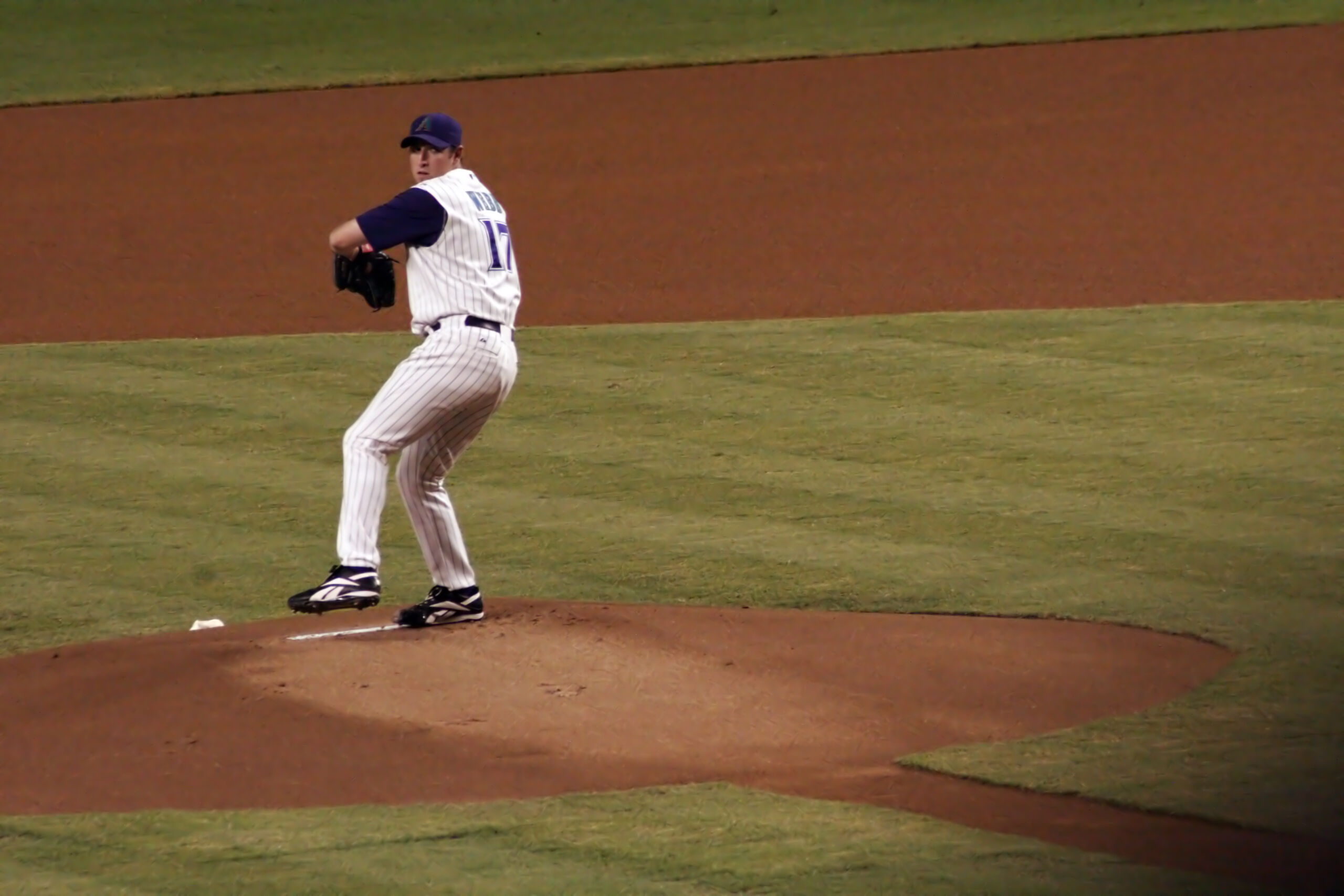
A pitcher sets up with a severely closed stance. His front foot is forward of his back foot. His hips and shoulders are turned away from the hitter. From center field, you can see two butt cheeks and the full jersey number.
On the surface, it makes sense.
If the problem is “flying open,” the solution must be to start closed.
Right?
Not so fast.
For a small group of pitchers, depending on their individual anatomy, movement history, hip structure, and natural coordination strategy, that setup may work. Some guys can live there. Some guys can even thrive there.
But it is rare.
For most pitchers, fighting to stay closed creates a new problem that is often worse than the original one.
Because the more you counter-rotate your pelvis, torso, and shoulders away from the hitter, the more real estate you have to cover just to get back to neutral.
I call it getting on the merry-go-round early.
You turn your back to the hitter. You preset rotation away from the target. Then, because you have created so much rotational distance to unwind, your body has to start spinning almost immediately just to get back to a reasonable delivery position.
That is not staying closed.
That is starting the carousel before the ride even begins.
And once the carousel starts spinning, command becomes a timing trick.
Imagine a five-year-old sitting on one of those carnival carousel horses. His grandmother is sitting on a bench outside the ride with her hands out, waiting for him to throw her the ball.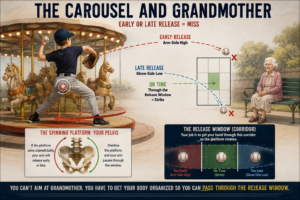
If the platform were still, the throw would be easy.
Point at Grandma. Throw it to Grandma.
But the platform is spinning.
Now the kid has to time the release perfectly.
One time he lets it go too early, and the ball sails high and to the arm side.
The next time he hangs on too long, and the ball spikes into the glove-side batter’s box.
Finally, he realizes the only way to get the ball to Grandma is to straighten his arm on the way by and sling it at the last second.
That is when the real trouble starts.
Because now he is not rotating around a stable platform.
He is chasing the throw with the arm.
In pitching terms, that often shows up as a linear deceleration pattern.
Instead of the arm turning over naturally through shoulder internal rotation and forearm pronation, the athlete reaches, extends, drags, and bangs across the front of the body. The biceps gets left to do a job it was never designed to do alone. The posterior cuff and periscapular muscles are late or underactive. The forearm may fail to pronate on time. The flexor-pronator mass — what we call the first responders of the UCL — may not be in position to help.
So the athlete who was just trying to “stay closed” may end up creating the exact deceleration pattern that puts the shoulder and elbow in jeopardy.
That is the cruel irony.
The cue was intended to improve command.
But for many pitchers, the strategy narrows the release window, forces early rotation, creates timing dependency, and increases stress downstream.
Pitching should not be an instant merry-go-round.
Pitching should be a controlled linear move toward home plate that allows rotation to happen late.
For a right-handed pitcher, that forward move should often feel like riding southeast.
For a left-handed pitcher, it often feels like riding southwest.
Not spinning toward the dugout.
Not showing the hitter your number.
Not presetting the pelvis into a position your body has to desperately unwind from.
Move forward first.
Create direction.
Hold the ride.
Rotate late.
That distinction matters.
Because “closed” is not the same thing as stable.
A pitcher can look closed and be wildly unstable. He can turn away from the hitter, hide the ball, show the jersey number, and still have no usable pelvic platform to rotate around.
At the ARMory, we are much more interested in hip lock and pelvic closure than the traditional idea of “staying closed.”
Hip lock happens when the athlete rides the back hip long enough to organize force into the ground and create a stable platform for forward movement.
Pelvic closure is not the pelvis staying turned away from the hitter forever. It is the pelvis arriving into a position where the front door can close at the right time, allowing the trunk and arm to rotate around something stable instead of chasing a spinning base.
That is the difference between movement and posture.
“Stay closed” is usually taught as a posture.
Hip lock and pelvic closure are movement events.
They have timing.
They have context.
They have a job.
And when they happen correctly, the pitcher does not need to consciously force himself to stay closed. His body organizes itself into a better solution.
The delivery becomes less of a timing trick and more of a stable sequence.
The release window widens.
The misses shrink.
The arm has a chance to turn over.
The biceps has a chance to shut off.
The posterior shoulder has a chance to decelerate.
The forearm has a chance to pronate.
The UCL has a chance to get help from the first responders.
That is what we are after.
Not a prettier pause.
Not a fake closed position.
Not a mechanical pose that looks good in a still photo but collapses under game speed.
We want a pitcher who can ride forward, organize force, delay rotation, and deliver the baseball through a stable release window.
So the next time a pitcher misses arm side and someone yells, “Stay closed,” pause for a second.
Ask the better question.
Is he really flying open?
Or is he starting so closed that he has no choice but to spin early?
Is the pelvis opening too soon?
Or did the pitcher put himself on the merry-go-round before he ever moved down the mound?
Is the arm the problem?
Or is the arm just trying to survive a platform that is rotating underneath it?
That is where development begins.
Not with a cue.
Not with a slogan.
Not with an old baseball phrase everybody repeats but nobody defines.
It begins with understanding what the body is actually doing.
Because the ball does not care what the cue was.
The arm does not care what the coach meant.
The tissue only responds to the movement environment you create.
And if the environment you create forces the athlete to spin early, chase the release point, and decelerate linearly, the cost can be command, velocity, performance, and eventually, the arm itself.
So no, I am not telling every pitcher to open up.
I am not saying every closed setup is bad.
I am saying we need to stop confusing “closed” with “stable.”
They are not the same thing.
And for many pitchers, the fight to stay closed may be the very thing wrecking the delivery.
Stop Guessing. Find Out What Your Delivery Is Actually Doing.
If your son has been told he is “flying open,” “pulling off,” or “needs to stay closed,” don’t keep piling cues on top of confusion.
The question is not whether he looks open or closed.
The question is whether his body is organizing in a way that protects his arm, expands his release window, and gives him a real chance to command the baseball.
At the Florida Baseball ARMory, we don’t guess. We evaluate.
In a One-on-One Precision Strike Evaluation and Training Session, we’ll assess how your pitcher moves, how he creates force, how he organizes his pelvis and trunk, and how those movement patterns show up in velocity, command, timing, and arm health.
One day.
One athlete.
One plan.
Stop chasing symptoms. Let’s find the real problem and build a better solution.
Schedule your Precision Strike Evaluation today.
floridabaseballarmory.com/precisionstrike
Or Call us at 866-787-4533 and we'll get you set up today.
About the Author:

Randy Sullivan, MPT, CSCS
CEO, Florida Baseball ARMory
Our founder and CEO, Randy Sullivan wears a bunch of hats: Physical Therapist, Baseball Instructor, Certified Strength & Conditioning Specialist, Paid Player Development Consultant to MLB teams, Public Speaker and of course an Author.